
Setting up your first fishing rod
How to put together your rod, reel, line, and bait

Assembling the fishing rod
Once your combo arrives, the first step is to attach the reel (the spinning part that holds the fishing line) to the rod (the long stick). You’ll slide the flat side of the reel into the small holes on the rod, and tighten the rod down around it. For future reference, this type of rod and reel is referred to as the commonly used spinning rod, as opposed to other more advanced types like a baitcaster, which uses a different type of rod and reel entirely.
Next up is attaching the line! While there are more “professional” ways to do it, the quickest and easiest way is:
Feed the tip of the line through the largest eyehole, towards the reel
Open the bail, the C-shaped piece of metal by flipping it up parallel with the rod
Avoiding the bail, tie the tip of the line to the reel as securely as you can (if you’re not familiar with knots, a “double knot” should work just fine. Most importantly, you want the line to stay tied when pulled on, and sit flush against the reel.
Once the line is tied tight, clip the tag end (the very end of the line), close the bail, and it’s time to start spinning it on! You can let the reel roll around freely while you crank the reel. Be sure to use a hand to apply some pressure to the line as you reel, so it lays on the reel evenly
Stop reeling once the line is approaching the “lip” of the reel and cut the line
If this was a bit confusing, here’s a pretty short and simple video guide:
Attaching your bait or lure
Now that your rod is assembled, feed the line through the remaining eyelets (holes) until it comes out the tip of the rod! You may need to open the bail and pull out some more line for yourself; it’s okay to have too much, you’ll want plenty of line to work with!
Which size hook to use? Bear in mind that the size of your hook affects which bait you should use, and the size of fish that you’ll be able to catch. A large hook won’t fit in a small fish’s mouth, and they’ll just nibble at your bait without ever touching the hook. Use a super small hook (10, 8, or 6) with corn if you’re targeting bluegill, or a more medium hook (1 or 2) if you’re going after bass, for example. While there are many types of hooks, the most important thing is that your hook doesn’t look obvious to a fish. If the water you fish is full of plants, it can be useful to change up how exposed the hook is to prevent picking up too many plants or algae. You might notice that some hooks or ways to attach the lure are called “weedless” for exactly this reason.
Attach the hook to the line: Now it’s time to tie a hook onto the line. It’s totally fine if you want to just use a double knot or similar, as long as it is totally secure when you pull firmly on the hook. I’d strongly recommend you learn the most basic fishing knot, the clinch knot, for a quick and easy way to tie the hook to the fishing line. After your line is tied and you pull firmly on the hook to tighten, clip off the tag end (the extra line), leaving a tiny bit of extra just for security (2-5mm).
Secure your chosen bait to the hook. There are many ways to do this, but here are two for the stick bait that have caught me a ton of bass.
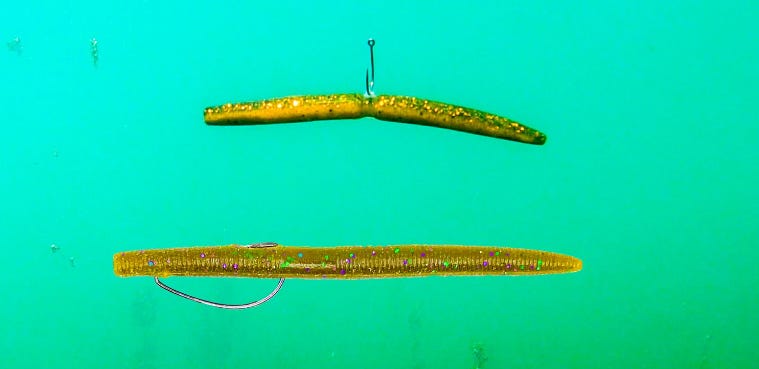
Note: these are both considered “weightless”, since they don’t add any additional weights to make it sink faster. This is something you can experiment with, especially if you’re in much deeper water and want to reach the bottom quickly.
I find the wacky rig easier for a first timer, since you can literally just poke the hook through the center of the bait, but I’ve had more luck catching fish with the Texas rig, so here’s a super easy guide for it:
Technically, now you’re ready to get out there and cast! You may wonder if you need a fishing bobber (the plastic bit that floats on the water), but in my opinion, it’s not necessary for this type of fishing and can even spook the fish, so I would highly suggest learning to actively fish without a bobber. You’ll quickly learn exactly what a fish bite feels like and when to reel it it without the visual cue. (Bobbers are however a requirement for other types of fishing.)
It’s time to move on to throwing your first cast!